Fabric vs Lattuce — AI second brain or cited academic writing?
Compare Fabric and Lattuce for AI workspace, deep search, and academic writing with citations and Word export.
Fabric is an AI workspace for notes, files, search, and agents — a cloud "second brain" with deep search, canvas, and apply-preview AI edits. Lattuce overlaps on notes, whiteboards, and Ask, but connects them to PDF sources, citation-verified compose, and Word export at lattuce.app.
If you love Fabric's unified capture and search, the question is whether you need a personal knowledge hub or research that ends in cited papers.
Quick comparison
| Fabric | Lattuce | |
|---|---|---|
| Core job | AI second brain + deep search | Research + writing at lattuce.app |
| Notes / PKM | Markdown docs, embeds, wikilinks | Vault, wikilinks, graph, offline shell |
| Canvas | Infinite canvas | Note whiteboards with clips and source cards |
| Search | NL, visual, media, cross-cloud | Spotlight + hybrid FTS/semantic on vault |
| AI assistant | Scoped context, apply-preview edits, agents | Spotlight Ask + Help with confirm-gated actions |
| Meeting / voice | Record, transcribe, discuss | Whisper in Learner ingest; no meeting-notes product |
| Integrations | 50+ cloud connectors | Zotero, MCP, browser extensions |
| PDF sources | Import into library | Integrated library, reader, missions |
| Academic writing | Generic editor | Writer with citation checks |
| Word export | — | Section approval → Word with references |
| Translation | — | Collaborative translation |
| Where it runs | Fabric cloud | lattuce.app cloud |
What Fabric still wins
- Unified capture: web clipper, email-to-Fabric, RSS subscriptions
- Deep search across connected clouds (Drive, Dropbox, Notion, Figma)
- Visual and color search; jump to transcript moments in audio/video
- Apply-preview AI document edits in the editor
- Scheduled agent jobs and per-agent email inboxes
- Publish any folder to a public website
- Sign up and start — no operator setup
What Lattuce wins
- Citation-verified compose — missions, grounding verifier, section approval
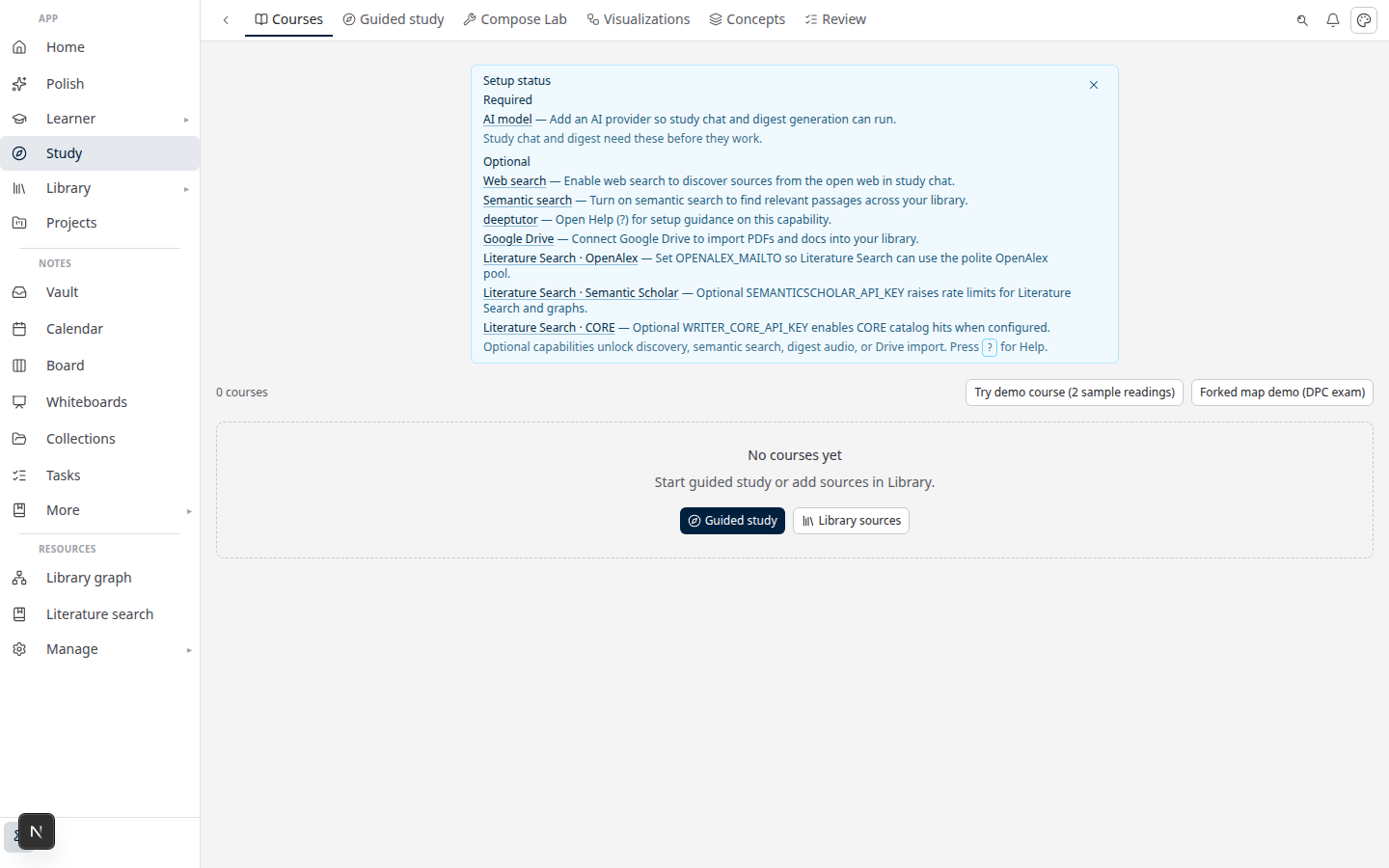
- Study over your PDFs — guided courses, digest artifacts, Revise chat
- Whiteboards linked to papers — synthesis that becomes cited sections
- Your own AI keys (BYOK) — choose the model provider for compose and study
- Collaborative translation for academic bilingual workflows
- Zotero-grounded library — no plugin stack for references
Workflow on Lattuce (coming from Fabric)
- Library — import PDFs and references instead of cloud connectors.
- Study or Revise — grounded chat over your sources.
- Notes → Whiteboards — spatial layout with source clips and note cards.
- Spotlight (Cmd/Ctrl+K) — search vault, library, navigate; Ask for help.
- Writer — turn ideas into cited sections; export to Word when ready.
When to use both
Keep Fabric for visual bookmarking, meeting notes, and cross-cloud search. Use Lattuce when boards and notes should feed papers with real citations at lattuce.app.
Bottom line
Choose Fabric for a polished AI second brain with minimal setup and broad integrations. Choose Lattuce when research should end in cited writing and bilingual translation in the cloud.
See also: Heptabase vs Lattuce · Obsidian vs Lattuce · NotebookLM vs Lattuce