Lattuce tutorial · Writer
Research projects in Writer
Plan research projects in Writer with milestones, tasks, boards, calendars, Gantt views, and shared team context.
Research Projects group multiple papers, milestones, tasks, and people around a thesis, grant, or research programme. They are different from a manuscript in Library and from a note collection under Notes.
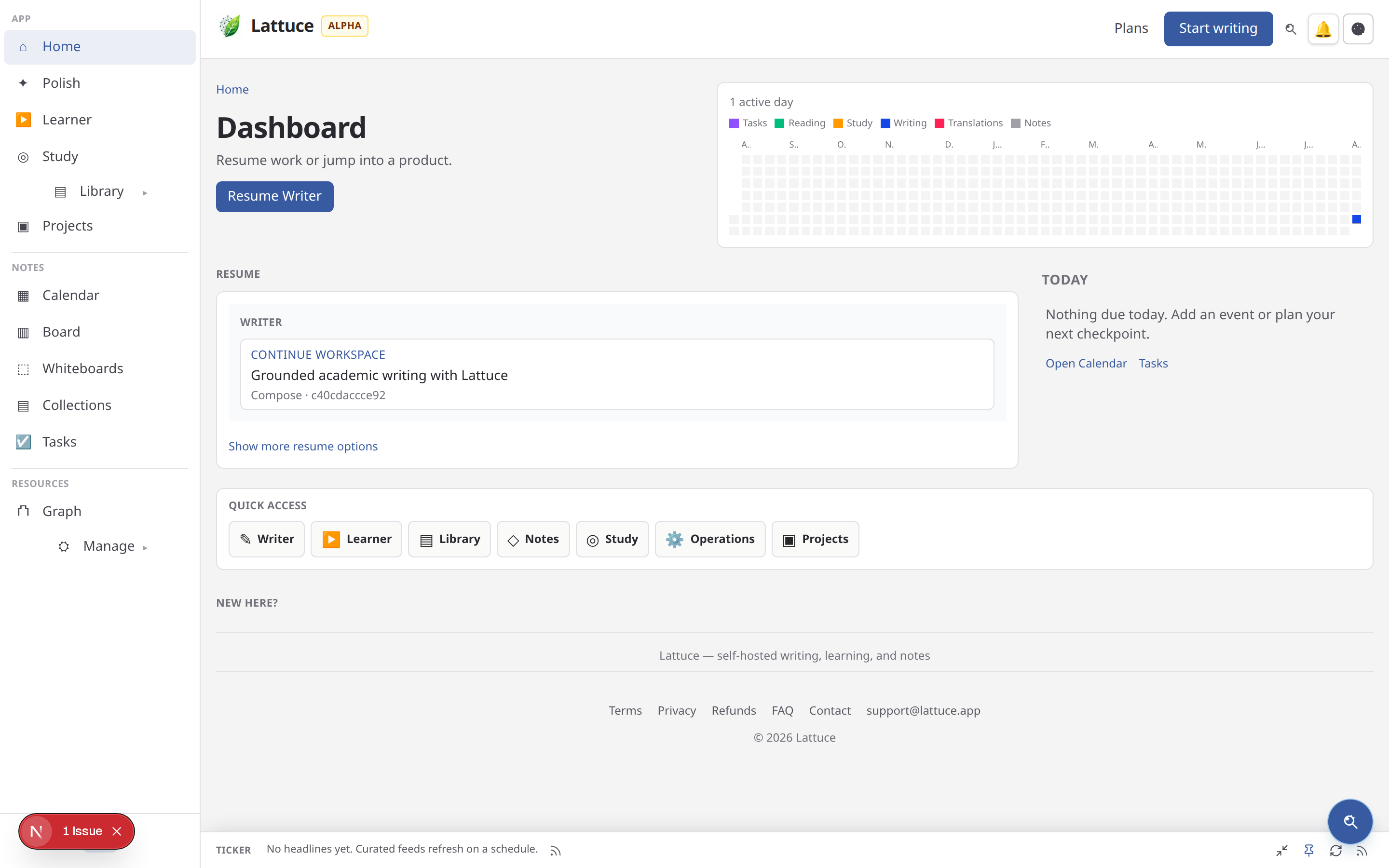
Use a project to answer “who is doing what, and by when?”. Keep the actual argument and evidence in the linked manuscript; project records should make coordination legible without duplicating the paper.
Create a project
Open Projects (/projects) and choose New project. Add a name, description, dates, and team members as appropriate. The project hub includes an Assigned to me filter so each person can see work that needs their attention.
Link the papers that belong to the project from the project dashboard. A linked paper keeps its own sources, sections, citations, missions, and export history; the project adds coordination around it.
Start with one project boundary and a small number of milestones. Add a task only when it has an owner or a clear next action. Link existing papers instead of making project copies, so status and export history remain authoritative in the manuscript.
Use the project views
The project dashboard provides a scoped agenda and progress summary. Use the view that matches the question you are asking:
| View | Best for |
|---|---|
| Board | Moving tasks through a small number of workflow columns |
| Calendar | Seeing due dates, meetings, and milestone timing |
| Gantt | Planning dependencies and the sequence of work |
| Dashboard | Reviewing linked papers, team, milestones, and current activity |
Tasks support a start date, due date, assignee, and dependency edges. The Gantt view prevents dependency cycles, so a task cannot become its own predecessor through a chain of links.
A practical thesis workflow
- Create one project for the thesis or research programme.
- Add milestones for proposal, data collection, analysis, chapter review, and submission.
- Link each manuscript or chapter paper.
- Add tasks with owners and due dates.
- Use the Board for weekly execution and the Calendar for deadlines.
- Use Gantt when a blocked task depends on another deliverable.
- Review the project agenda before a lab or supervisor meeting.
Keep evidence and prose inside the linked paper. Keep coordination, ownership, and deadlines inside the project. This boundary makes it clear what belongs in a manuscript and what belongs in the programme plan.
Weekly project review
- Open Assigned to me and clear or reschedule overdue tasks.
- Check milestones against linked paper progress.
- Use Board for the next week’s execution and Gantt for dependencies.
- Record decisions in a linked Notes page instead of burying them in a task title.
- Leave one visible next action for every active paper.
Notes and project scope
Notes can still hold meeting records, decisions, reading notes, and daily journals. Link those notes to the relevant paper or project when useful. Notes collections (/collections) are ordered note groups for drafting and compiling; Research Projects (/projects) are the cross-paper coordination layer.
Access and troubleshooting
Projects are account-scoped. If a paper or task is missing, check that you are in the correct account and that the item is linked to this project. If a date appears in the wrong view, verify whether it is a task due date, a milestone date, or a calendar event. For a paper’s actual writing progress, open the linked manuscript rather than relying only on the project board.
Related: Starting a new paper · The Writer paper lifecycle · Notes workflows
Browse more in Writer or return to all tutorials.